- Published on
How to Save Time on Therapy Documentation Without Losing Quality
- Authors
- Name
- Bella Martini

Introduction
- Capture Information While It Is Fresh
- Use Templates and Better Starting Points
- Keep the Workflow Connected
Therapists do not usually struggle with documentation because they do not care about it. More often, they struggle because it competes with every other part of a full clinical workload.
The real problem is not only the number of notes, reports, and letters that need to be written. It is the constant context switching, the mental fatigue at the end of a long day, and the blank-page friction that makes every document feel heavier than it should.
Saving time does not have to mean lowering standards. In many cases, better documentation systems improve quality because they reduce inconsistency and help therapists follow a clearer process.
Capture Information While It Is Fresh
One of the simplest improvements is to capture information while it is still fresh. Quick typed notes, voice notes, and immediate post-session summaries reduce the effort required later. The longer a therapist waits, the more energy it takes to reconstruct what happened.
Use Templates and Better Starting Points
Templates are another major time saver. If clinicians repeatedly write similar reports or progress updates, a good template removes unnecessary setup work and helps standardise structure across the team.
It also helps to reduce blank-page friction. Starting from nothing is often the slowest part of documentation. Tools that can help turn rough notes into a usable first draft give therapists something to refine instead of something to build entirely from scratch.
Keep the Workflow Connected
The best workflows also keep information in one place. When clinicians have to jump between emails, separate note files, attachments, and copied text, time disappears quickly. A cleaner workflow protects focus.
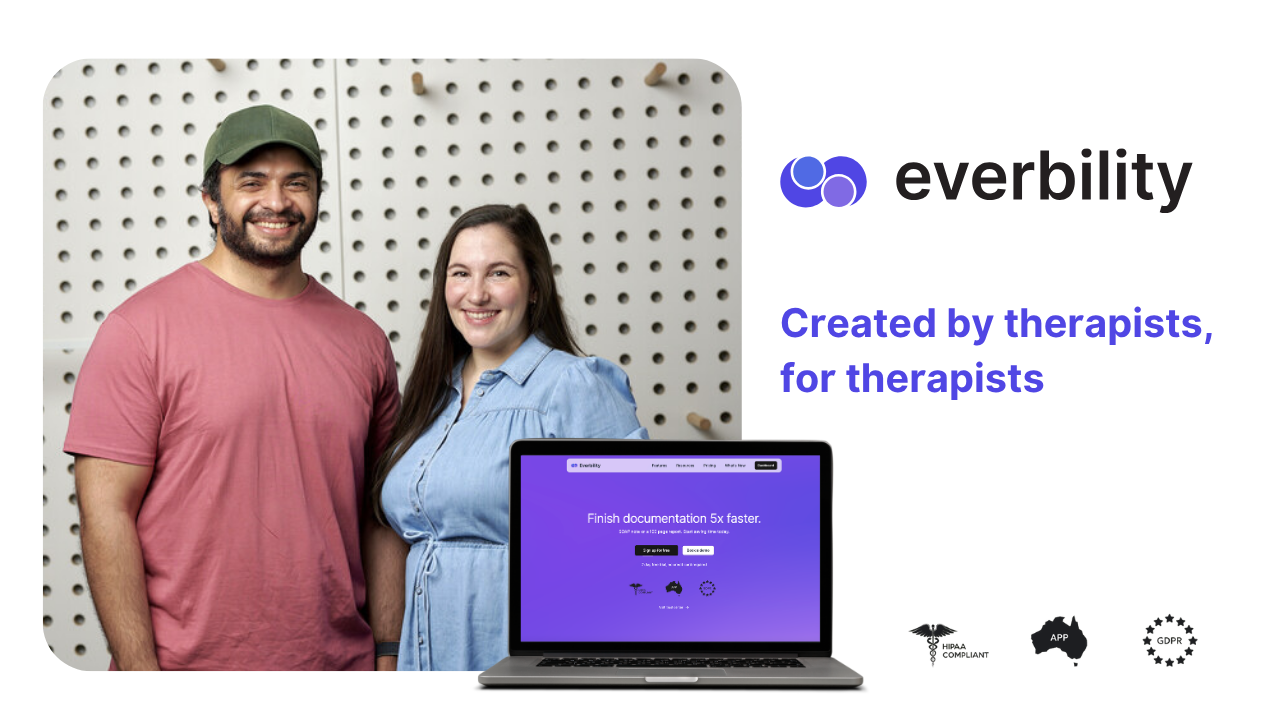
Everbility is designed around this reality. It helps therapists capture information in multiple formats, use reusable templates, generate drafts more quickly, and edit within the same workflow.
Better documentation systems do not cut corners. They remove unnecessary friction so quality work becomes easier to complete consistently.