- Published on
What to Look for in AI Tools for Allied Health Professionals
- Authors
- Name
- Bella Martini
Introduction
- Start With Clinical Relevance
- Flexible Inputs and Reusable Templates Matter
- Privacy and Practical Time Savings
AI tools are appearing across healthcare, but not every tool is built for the realities of allied health work.
For therapists and clinic leaders, the best tool is not the one with the most impressive marketing. It is the one that actually fits the way documentation happens in practice.
Start With Clinical Relevance
The first thing to look for is clinical relevance. Generic writing tools may be able to produce text, but allied health teams need systems that understand documentation structure, variation in report types, and the importance of context and review.
Second, look for strong review control. Therapists need to be able to edit wording, adjust tone, and confirm that the final document reflects the true clinical picture. If the workflow makes review difficult, the time savings will not hold up.
Flexible Inputs and Reusable Templates Matter
Third, flexible inputs matter. Clinicians do not always have polished notes ready to go. Sometimes they have voice notes, handwritten observations, uploaded PDFs, or mixed materials gathered across a busy week. Good tools should work with that reality.
Templates are another key feature. Reusable structures help clinicians move faster and create consistency across common workflows.
Privacy and Practical Time Savings
Security and privacy also matter. Healthcare teams need clear handling practices, transparent positioning around data, and confidence that sensitive information is being treated appropriately.
Finally, ask the simplest question of all: does this tool actually reduce work after hours? If it does not improve day-to-day reality for therapists, it is probably not solving the right problem.
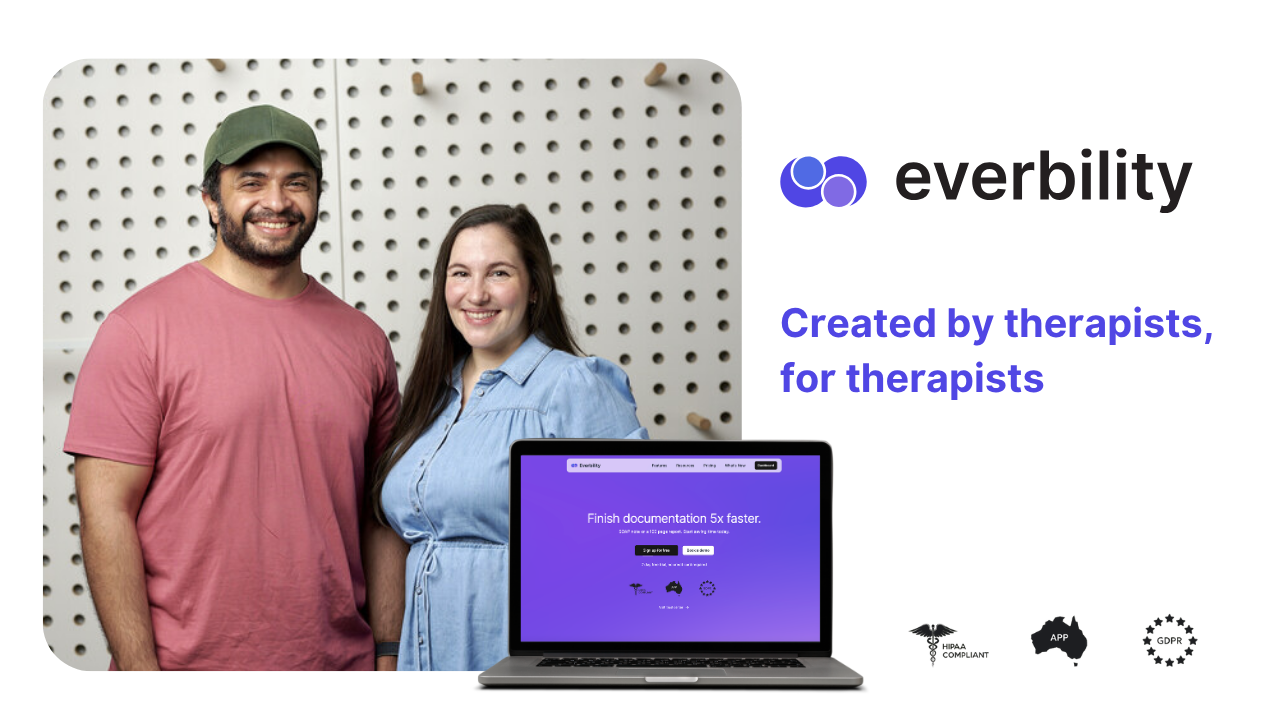
Everbility stands out because it was built specifically for allied health professionals. It supports multi-format capture, templates, AI-assisted drafting, and in-workflow editing, all with the goal of reducing admin pressure without undermining clinical judgment.